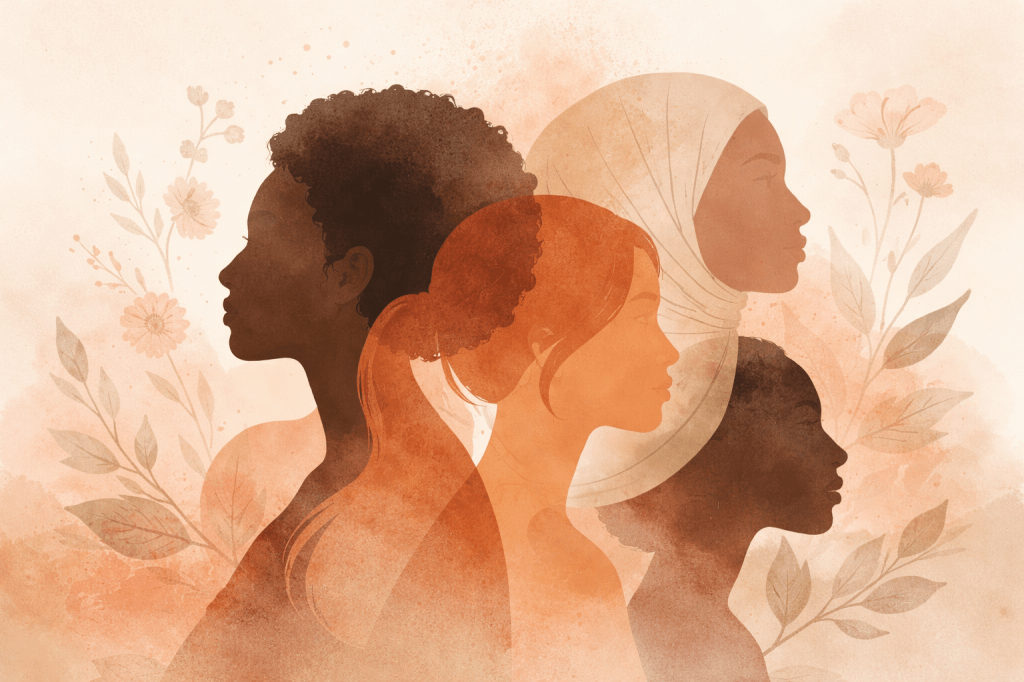
Now that I am in my Masters and (hopefully) moving into the PhD space, I thought I would write about what motivates me most as a baby researcher, and the theoretical framework that grounds my work.
When you begin research, one of the first questions you’re asked is: What is your theoretical framework?
A theoretical framework is the foundation of a study. It is the groundwork. The lens. The perspective that guides how a researcher understands a problem, gathers knowledge, and interprets findings. It shapes what we notice, whose voices we centre, and what we believe counts as knowledge.
For me, that lens is Feminist Standpoint Theory.
Where Feminist Standpoint Theory Began
Feminist Standpoint Theory emerged in the 1970s and 1980s through the work of scholars such as Sandra Harding, Nancy Hartsock and Dorothy Smith. These second-wave feminist thinkers argued something quite radical at the time:
- Knowledge is not neutral.
- Who we are shapes what we can see.
They proposed that people who have been historically marginalised, women, people of colour, working-class communities, disabled communities, often have unique and critical insights into how power operates in society. Not because they are “better,” but because living on the margins reveals structures that those at the centre may never need to notice.
Standpoint theory does not argue that women are superior to men. It argues that lived experience matters, and that research should take seriously the voices of those who have been historically excluded from knowledge production.
The Misconception About Feminism
Recently, I had a conversation (argument, if I’m honest) with a friend who insisted that feminism is solely about “hating men.”
Sigh.
This is one of the most persistent misunderstandings of feminism.
Feminist Standpoint Theory is not about women “over” men. It is not about reversing power hierarchies. It is about examining them. It asks:
- Who has historically been heard?
- Who has been silenced?
- Who gets to define what counts as knowledge?
- Whose experiences are treated as “normal”?
At its core, Feminist Standpoint Theory is about equity and representation. It recognises that systems of power affect people differently depending on gender, race, class, sexuality, disability, Indigeneity, and cultural background. It encourages us to listen to those who have been “othered” and to take their knowledge seriously.
That feels deeply aligned with both my teaching and my research.
Why This Matters in Art Education
As a Visual Arts teacher and researcher, I am constantly aware of whose stories are amplified in the curriculum, and whose are missing.
When we teach art history, whose names dominate?
When we talk about “great artists,” who is centred?
When we examine artistic genius, whose labour is invisible?
These questions are not abstract for me. They sit directly inside my research on Female Visual Arts Teachers, their self-efficacy, their professional identity, and their artistic embodiment.
Using a Feminist Standpoint framework allows me to:
- Centre the lived experiences of female teachers.
- Acknowledge structural barriers rather than individual “deficits.”
- Recognise that teaching while identifying as female (and often carrying invisible labour) shapes professional identity.
- Treat participants not as subjects, but as knowledge-holders.
It allows me to say: your experience is not anecdotal. It is data. It is theory. It is knowledge.
Standpoint Is Not About Exclusion, It Is About Expansion
One of the most powerful elements of Feminist Standpoint Theory is that it has evolved. Contemporary feminist scholarship is intersectional. It recognises that gender does not operate in isolation from race, class, Indigeneity, disability, or sexuality.
Standpoint theory asks us to widen the lens.
It asks us to consider how power operates in layered ways. It invites research that is reflexive, that acknowledges the researcher’s own position in the world.
As a female Visual Arts teacher researching female Visual Arts teachers, I cannot pretend to be detached or neutral. My standpoint shapes what I see. Rather than hide that, Feminist Standpoint Theory asks me to make it visible.
That feels honest.
Why It Emboldens Me
Feminist Standpoint Theory has emboldened me to focus on ways in which those of us who have been marginalised can be heard in the world, not as victims, but as theorists of our own experience.
It gives me permission to say that lived experience is not lesser than abstract theory.
It reminds me that research is not just about filling gaps in literature; it is about challenging the structures that created those gaps in the first place.
And perhaps most importantly, it aligns with the way I teach.
In my classroom, I want my students, all of them, to feel that their stories matter. That their cultural background matters. That their gender, their identity, their experiences are not peripheral to art, but central to it.
My research is simply an extension of that belief.
Final Thoughts
So no, Feminist Standpoint Theory is not about hating men.
It is about interrogating power.
It is about valuing lived experience.
It is about making space at the table for voices that have long been excluded.
As I step further into academia, this is the lens I choose to work through.
Not because it is trendy.
Not because it is radical for the sake of it.
But because it feels true to my practice, my profession, and my values.
And as a baby researcher, that feels like a very good place to begin.
 Cultivating Creativity: Best Practices for the Art Classroom
Leave a comment