Feeding the Senior Visual Art Syllabus Downwards
As a Visual Art team, we began noticing a clear gap between students completing Year 10 Visual Art and moving into Year 11 General Visual Art. While many students were confident makers, they often needed more support with the expectations of the senior syllabus, particularly when responding to inquiry questions, analysing artworks, and understanding the role of context in both making and responding.
Rather than waiting until Year 11 to introduce these expectations, we made a deliberate decision to feed aspects of the QCAA Senior Visual Art syllabus down into the junior years. Our aim was not to make junior Visual Art feel like senior assessment, but to gradually and implicitly build the knowledge, language, confidence and habits students would need later.
We began by identifying the areas students found most challenging when entering senior Visual Art. These were:
- answering an inquiry question
- analysing artworks with depth and accuracy
- understanding and applying the four contexts: personal, cultural, contemporary and formal
In General Visual Art, students engage with all four contexts across Year 11 and Year 12, with two contexts explored in Year 11 and two in Year 12. To support this progression, we mapped the four contexts backwards through our junior units. We looked carefully at our existing unit plans and considered which context naturally suited each year level and learning focus.
In Year 7, our priority is for students to learn the elements of art, develop confidence with materials, and most importantly, learn to enjoy the subject. We want students to feel successful, curious and engaged in Visual Art before adding more complex analytical expectations.
In Year 8, we introduce the formal context. Students begin focusing on how artworks are made, with attention to skill, technique, materials, processes, the elements of art and principles of design. This supports students in developing stronger visual literacy and more specific language when discussing artworks.
In Year 9, we introduce the cultural context through units that explore Australian identity, First Nations perspectives and contemporary Australian artists. Students begin to consider how artworks communicate ideas connected to culture, place, identity and representation.
In Year 10, students engage with both the personal and contemporary contexts. In Semester 1, the Identity unit focuses on personal context, asking students to explore self, symbolism and lived experience. In Term 2, students continue working with personal context through protest art, considering how artists communicate personal beliefs, values and political viewpoints in response to real-world issues. In Semester 2, students move more explicitly into contemporary context through units that examine 21st century artworks, identity, social issues, nostalgia, memory and current visual culture.
To support this structure, we also adjusted the way students submit work. Across Years 8–10, students complete a folio-style body of work that includes journal work, resolved artworks, artist statements and written responding tasks. This mirrors the structure of senior Visual Art in an age-appropriate way, allowing students to gradually understand that artmaking is not just about the final artwork, but also about research, experimentation, reflection and communication of meaning.
For written assessment, students complete exams based on an artist in focus and the relevant context for the unit. These exams allow students to practise reading and responding to an inquiry question, analysing artworks, and using evidence from the artwork to support their ideas. In Years 8–10, students are still given guiding information to support their responses. For example, when analysing Richard Bell, students are provided with contextual information about First Nations perspectives to help them build a more informed response.
This approach has been successful in strengthening students’ confidence and depth of understanding. We are seeing more students using literal and non-literal interpretations when responding to artworks. Students are also beginning to analyse artworks using the elements of art and principles of design with greater depth, moving beyond simple statements such as “the artwork uses line” and towards more meaningful explanations of how visual language communicates ideas.
The use of exam preparation has also become an important part of our teaching. Students are explicitly shown how to read an inquiry question, identify what the question is asking, and structure a response that addresses both the artwork and the context. This modelling has helped students become more confident in responding to artworks and has created a stronger foundation for senior Visual Art.
While this approach begins in Year 7 and continues through Year 8, the following overview focuses on selected examples from Years 9 and 10. This allows us to share the thinking behind our curriculum planning while still keeping our full program documentation internal. These examples show how we have embedded senior Visual Art expectations into junior units, and how our folio, artist statement and exam structures support students to gradually build confidence with inquiry, context and analysis.
Selected Planning Examples from Years 9–10
The following examples show how we have begun embedding senior Visual Art expectations across the junior years in a way that is purposeful, scaffolded and connected to our existing curriculum.
Year 9
Term 1: Pop Art
Context focus: Cultural context
Artist focus: Richard Bell, Kaylene Whiskey, Franck Gohier
Project: Pop Art inspired artworks, including a drawing task, collage and painting
Exam: Students respond to a selected Richard Bell artwork that uses similar Pop Art techniques. Students answer two questions analysing the cultural context. Guiding information is provided to support students, such as information about Richard Bell and First Nations perspectives.
Year 10
Term 1: Identity
Context focus: Personal context
Artist focus: Reverse chronology is introduced through Del Kathryn Barton, Yasumasa Morimura and Frida Kahlo
Project: Del Kathryn Barton inspired self-portrait
Artist statement: Students explain how they have used personal context to create meaning in their portrait.
Term 2: Social Issues
Context focus: Personal context
Artist focus: Shepard Fairey
Project: Printmaking protest folio based on a chosen social issue
Exam: Students answer two questions about a Shepard Fairey artwork, analysing how his personal beliefs, values and political viewpoints are communicated through visual language.
This unit allows students to explore how artists use imagery, symbolism, text and composition to communicate personal beliefs about real-world issues. Students are introduced to Fairey’s Obama Hope poster during practice exam preparation, where they examine how political ideas can be communicated through visual language. They then extend this understanding by analysing Fairey’s posters responding to the war in Gaza, considering how an artist’s personal position can shape meaning, audience response and interpretation.
Term 3: Contemporary Identity
Context focus: Contemporary context
Artist focus: Shaun Gladwell and Vernon Ah Kee
Project: Clay mini surfboard inspired by Vernon Ah Kee, embedded with student identity symbols and patterns
Artist statement: Students explain how their artwork introduces and communicates a contemporary context.
Term 4: 21st Century Artworks
Context focus: Personal and contemporary contexts
Artist focus: Carmen Hui
Project: Carmen Hui inspired A2 coloured pencil drawing
Exam: Students answer two questions about a Carmen Hui artwork, analysing both the personal and contemporary contexts.
This unit explores how Carmen Hui interprets contemporary Australia through imagery connected to memory, place and nostalgia. Students consider how Hui’s artworks represent familiar Australian experiences, objects and environments, while also inviting audiences to connect through their own memories of Australia. Through this, students analyse how personal memories and shared cultural nostalgia can shape the meaning of contemporary artworks.
Year 11–12 Visual Arts in Practice
This approach also extends into Year 11 and 12 Visual Arts in Practice. While Visual Arts in Practice is an Applied subject and has different assessment expectations to General Visual Art, we still wanted students to have access to the language, concepts and structure of the syllabus in a supported way.
Across Year 11 and 12, students engage with all four contexts through their workbooks, with one context introduced in each unit. These workbooks are also available through Visual Art Resources and include explicit breakdowns of the Visual Arts in Practice syllabus, allowing students to understand what they are learning, why they are learning it, and how it connects to their practical artmaking. The image below is a photo of my classroom whiteboard where as a class we analysed a Banksy artwork together and linked it to our own artworks in an artist research task.
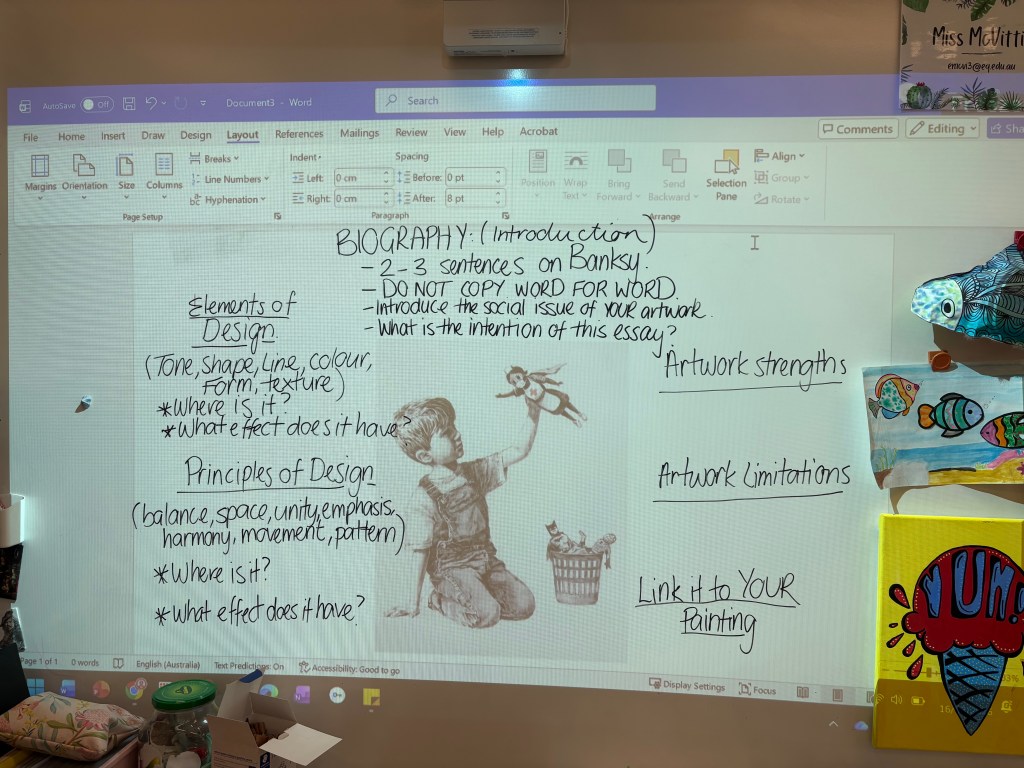
As our department teaches QAR, or Question and Answer Relationships, we have converted syllabus and context learning into QAR-style worksheets. This allows Visual Arts in Practice students to access syllabus language and contextual analysis in a safer, more scaffolded way. Rather than overwhelming students with dense syllabus documents or senior terminology, the QAR worksheets break the learning into manageable questions that guide students towards understanding.
This has allowed our VAP students to build confidence with context, analysis and reflection while keeping the learning accessible and connected to their own artmaking. It gives students exposure to the syllabus at a safer distance, with less pressure, while still supporting them to develop stronger visual literacy and more meaningful written responses.
Through this approach, our Visual Art program has become more connected, intentional and future-focused across both junior Visual Art and senior Visual Arts in Practice. Students are not simply learning isolated skills each year; they are gradually building the visual, written and conceptual language needed to understand artworks, communicate ideas and reflect on their own practice. By the time students enter senior Visual Art pathways, they have already encountered inquiry questions, folio processes, artist statements, contextual analysis, QAR strategies and visual language. This gives them a stronger foundation and helps them step into senior learning with greater confidence.

