This page is your go-to destination for teaching the Principles of Design in meaningful, engaging, and contemporary ways. Whether you’re a new or experienced Visual Arts teacher, you’ll find downloadable resources, lesson plan ideas, and inspirational artist links to bring concepts like balance, contrast, emphasis, movement, pattern, rhythm, unity, and variety to life in your classroom. Each resource is designed to be adaptable, curriculum-aligned, and connected to contemporary artists, making the principles relevant and exciting for your students. Check back often, new content is added regularly!
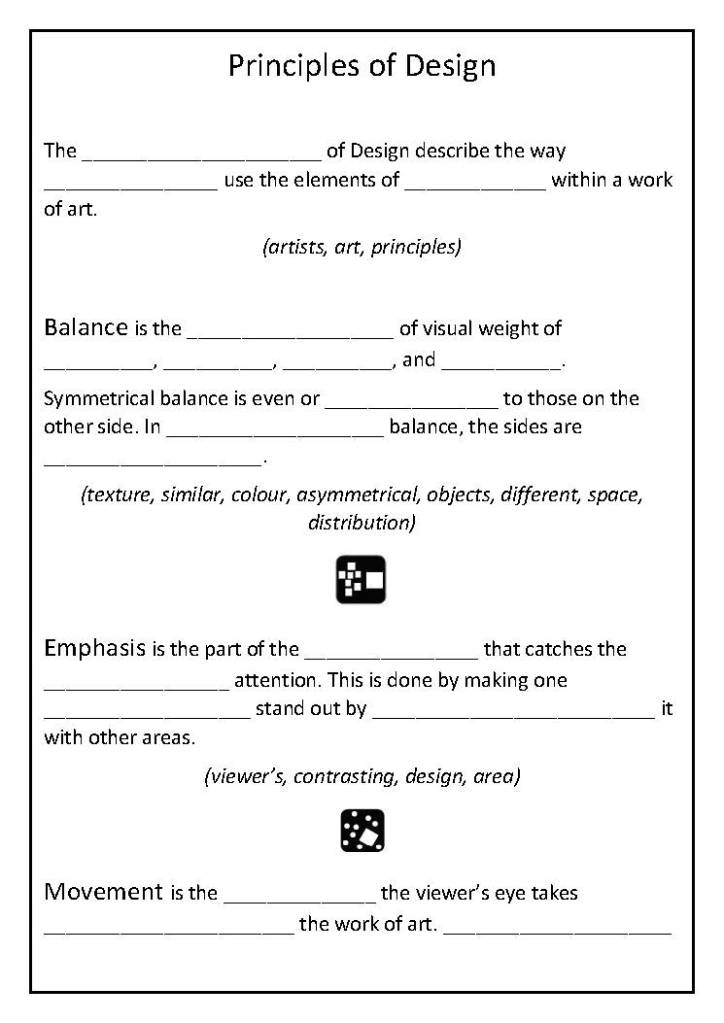
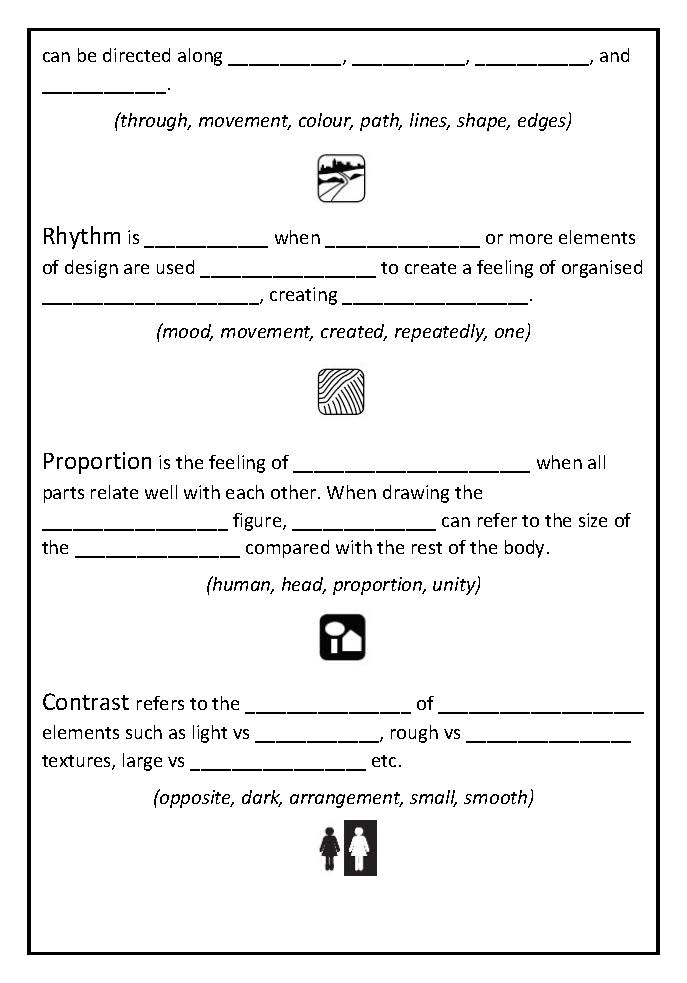
Principles of Design Worksheet:
Lesson Plan Ideas:
⚖️ 1. Balance – Symmetry, Asymmetry, and Radial Design
Lesson Idea: Students create three small compositions demonstrating symmetrical, asymmetrical, and radial balance using collage or digital design.
Contemporary Artist: Yayoi Kusama – her installations and paintings use symmetry and repetition to create visual harmony.
Extension: Analyse how balance affects emotional tone and composition in different cultural artworks.
⚡ 2. Contrast – Light vs. Dark, Rough vs. Smooth
Lesson Idea: Use charcoal, ink, or digital tools to create high-contrast portraits or still life drawings.
Contemporary Artist: Kara Walker – uses strong black-and-white contrasts in silhouette work to discuss historical and racial themes.
Extension: Encourage students to explore emotional or narrative contrasts using colour, line, or content.
🎯 3. Emphasis – Focal Point and Visual Hierarchy
Lesson Idea: Students choose a subject and design an artwork where the eye is drawn clearly to a specific focal point using scale, colour, or isolation.
Contemporary Artist: Del Kathryn Barton – known for highly detailed artworks that use scale and repetition to draw attention to the central figure.
Extension: Explore how advertising and media use emphasis for persuasive visuals.
🌀 4. Movement – Guiding the Eye
Lesson Idea: Students use flowing lines, repetition, or dynamic composition to guide the viewer’s eye through their artwork.
Contemporary Artist: Sougwen Chung – merges AI and hand-drawn marks to explore organic vs. mechanical movement.
Extension: Create a time-lapse drawing or GIF to visualise movement digitally.
🔁 5. Pattern – Repetition with Purpose
Lesson Idea: Create repeat patterns inspired by cultural motifs, personal identity, or nature using drawing, printmaking, or digital tools.
Contemporary Artist: Sofia Crespo – uses AI to generate biologically inspired patterns and textures.
Extension: Explore the difference between random repetition and structured pattern.
🎵 6. Rhythm – Visual Beat
Lesson Idea: Use rhythm to create visual flow through repeated elements that change in size, colour, or shape (e.g., abstract rhythm paintings).
Contemporary Artist: Rebecca Louise Law – known for immersive floral installations that create a physical rhythm in space.
Extension: Play music and have students visually interpret the beat through marks and spacing.
🤝 7. Unity & Variety – Cohesion with Complexity
Lesson Idea: Students create a mixed media piece where diverse elements are unified through consistent colour, shape, or theme.
Contemporary Artist: Sarah Sze – builds chaotic yet unified sculptural installations.
Extension: Group critique on what creates unity vs. disconnection in their work.
 Cultivating Creativity: Best Practices for the Art Classroom