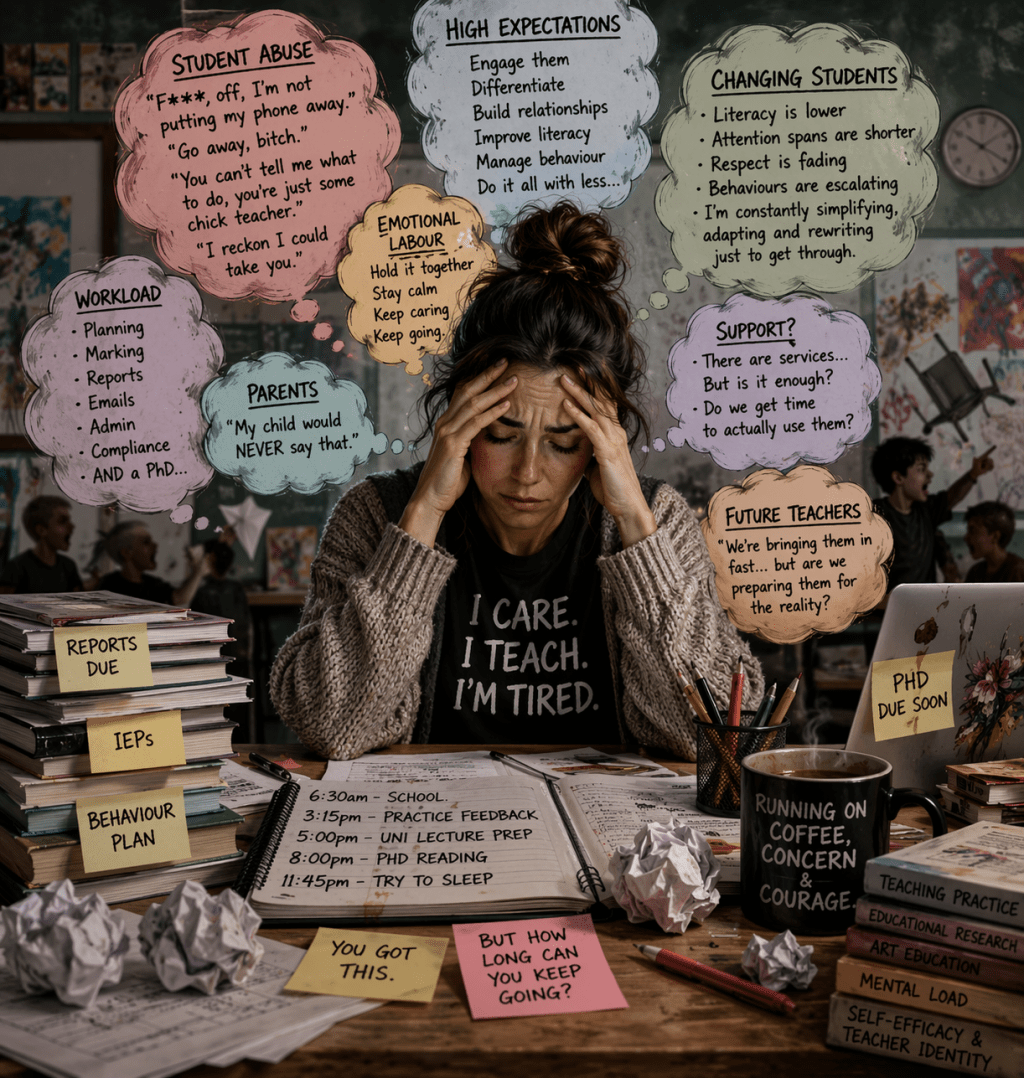
I think it’s important to start this honestly, because right now, my current reality as a teacher looks like this: I teach full-time at a high school, I study part-time at a research level as I work towards my PhD, and I also have a teaching contract working at uni, teaching undergraduate students at Griffith University.
Don’t get me wrong, I’m aware of how full my plate looks, and I’m lucky that I work at a school where I am deeply supported. For me, I’m in a good spot. I’m researching my passion, I’m in the classroom teaching art where my heart sings, and I’m teaching at a university level which is a step towards my ultimate career goal.
So things feel good.
But what about those who don’t?
See, I’m lucky because I have a great team I work with, but it wasn’t always like that, and many teachers don’t have a village of people to love and support them. I’m noticing how quickly teachers have started fading, and Term 1 is only just over. Those Week 10 feels felt like Term 4 feels, and seeing my colleagues beginning to fatigue worries me. If this is what it looks like in a school where staff are supported, what about those who aren’t?
And it’s not just a feeling. Across Australia, teaching is becoming harder to sustain. Recent national workforce data shows that only 26% of teachers intend to stay in the profession until retirement, while 39% are already planning to leave, and another 35% are unsure. At the same time, teachers are working an average of around 50 to 52 hours per week during term time, with most working well beyond standard hours. The biggest reasons are workload, administrative pressure, stress, and increasingly, student and parent behaviour.
Teachers, pre-service teachers, undergraduate students, I’m seeing fatigue everywhere. Workload has increased, particularly in administrative tasks, while at the same time we are being asked to maintain classroom expectations that feel like they have shifted significantly.
And in my own professional experience, classrooms feel different.
I won’t generalise beyond what I see every day, but I will say this. I am having to rewrite literacy tasks two to three years below year level, and even then, I still have students who struggle to read and comprehend instructions. I no longer write in cursive on the board or in feedback because students can’t read it. I write in block letters, simplify sentence structures, and adjust constantly just to ensure access.
Nationally, data reflects that this is a pressure point. In 2024, only around 63% of Year 9 students were achieving at or above the “Strong” proficiency level in reading, and around 61% in writing. That means a significant number of students are entering our classrooms without the literacy skills we are expected to build upon.
And that’s only part of the story.
There are also increasing reports of student aggression and abuse towards teachers. Not just raised voices. I mean desks thrown, objects used as weapons, teachers being hit, kicked, or threatened. National data shows that Australian school leaders are reporting high rates of physical violence and threats of violence within school settings, and that intimidation and verbal abuse from students occurs weekly in a number of schools.
I have lived this.
I have had a colleague have an apple thrown at her head, full force, only for the student to deny it and for the situation to disappear due to lack of witnesses. I have had a student take a box cutter from my desk, pull the blade, hold it towards me and say, “I reckon I could take you,” because I asked him not to mix the playdough. That moment relied on calm repetition and peer intervention before he de-escalated. His consequence was an apology.
Daily, I am verbally abused. “Fuck off, I’m not putting my phone away.” “Go away bitch.” “You can’t tell me what to do, you’re just some chick teacher.” These are not isolated incidents. They are part of the everyday landscape of teaching for many of us.
And perhaps one of the hardest parts is this. When we speak to parents, we are often met with disbelief. “My child would never say that.” And the conversation ends there.
Again, this is not every school, and I am in a context where behaviour is followed up. I am supported. But even within supportive systems, the strain is still there.
There are supports available to teachers in Australia. National initiatives like Be You focus on educator wellbeing, and services such as Beyond Blue and the Black Dog Institute offer mental health support. Systems like Education Queensland provide Employee Assistance Programs, offering access to counselling services for staff. These supports matter, and they are important.
But I keep coming back to the same question. Are they enough?
Because support systems often respond to burnout, rather than prevent it.
And then I think about my undergraduate students.
The pre-service teachers I am teaching right now at Griffith. The ones who are passionate, hopeful, creative, and ready to enter the profession. The ones who are being fast-tracked through ready to teach initiatives, internships, and alternative pathways designed to address teacher shortages.
In Queensland alone, there are funded internships, scholarships, and financial incentives designed to bring more people into the profession. There are pathways that allow students to teach while still completing their degrees. There are real efforts being made to grow the workforce.
But I can’t help but ask. What are we preparing them for?
Are we preparing them for the emotional labour? For the behavioural realities? For the workload that extends far beyond the classroom? Are we equipping them not just with pedagogy, but with the capacity to sustain themselves in a profession that is asking more and more of them?
Because right now, we are bringing people into a system that many experienced teachers are struggling to remain in.
And that tension sits heavily with me.
I love teaching. I love my classroom. I love my students. I love the moments where learning clicks, where creativity emerges, where connection happens. That hasn’t changed.
But something else has.
And I don’t think we can ignore it anymore.
Because if this is what Term 1 feels like, we have to ask ourselves. What happens next?
Further Reading
If you’re interested in understanding more about teacher workload, wellbeing, and the future of the profession in Australia, these are some key reports and resources worth exploring:
- Australian Institute for Teaching and School Leadership — National teacher workforce data and trends
- Australian Curriculum Assessment and Reporting Authority — National schooling and NAPLAN reporting
- Australian Parliament House Parliamentary Library — Research on classroom disruption and behaviour
- Australian Catholic University — Principal health, safety, and wellbeing survey
- Beyond Blue — Mental health support and the Be You initiative for educators
- Black Dog Institute — Teacher wellbeing resources and research
- Queensland Department of Education — Teaching workforce strategy and future pathways


Leave a Reply