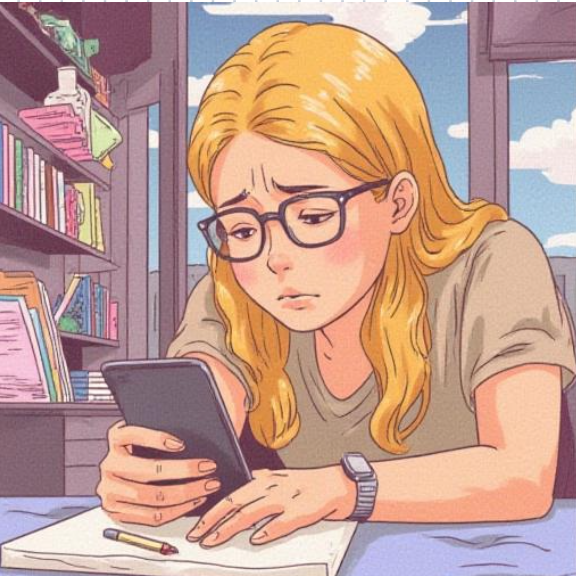
I think I’ve become a victim of the evils of social media.
This week, my teacher Instagram lost 50 followers in one day and has continued to decrease, which, for a small account, is annoyingly obvious.
And what stopped me was that this upset me.
It upset me that my Instagram doesn’t have a lot of followers. It upset me that it was losing followers.
Why?
And when I ask myself, why am I upset?, the answers start to swirl:
Because I want to be known within the teacher Instagram community.
Because I want to have reach without being labelled an influencer.
Because I want to know that my posts mean something to someone.
Because I put time into creating things and sharing them, and apparently some tiny part of my brain has decided that numbers on Instagram are a perfectly reasonable way of measuring whether any of that matters.
And then the vicious cycle just continues to swirl.
De et al. (2025) examined the neurobiological impact of prolonged social media use, focusing on its relationship with the brain’s reward, attention and emotional-regulation systems. Although their paper focuses specifically on adolescents, their discussion of dopamine pathways, reward processing and changes in activity within areas including the prefrontal cortex and amygdala made me think about just how deeply social media can become tangled up with the way we respond emotionally to what happens on our screens.
Which brings me back to my disappearing Instagram followers.
Dopamine is a neurotransmitter, a chemical messenger in the brain, and while it is often casually described as our “feel-good” chemical, it actually has a much broader role in pleasure, satisfaction, motivation, mood, learning and concentration (Healthdirect Australia, 2025). When we do something enjoyable or rewarding, dopamine helps reinforce that behaviour and encourages us to want to do it again.
So, likes? Nice.
Comments? Lovely.
A new follower? Excellent. Tiny brain reward.
Fifty people disappearing in one day?
Apparently my brain would like to lodge a formal complaint.
Fernandez (2022) discusses the insecurity and anxiety that can accompany social media use and the enormous growth of these platforms. Citing Pew Research Center data, Fernandez notes that only 5% of American adults used at least one social media platform in 2005; by 2021, that figure had risen to 72%.
That is an enormous cultural shift in a relatively short period of time.
Stanford psychiatrist Dr Anna Lembke has also explained how repeated exposure to highly rewarding stimuli can push dopamine activity below its usual baseline after the initial increase, creating what she describes as a dopamine-deficit state. With repeated exposure, this can contribute to us wanting to return to the behaviour again and again, even when it isn’t necessarily making us feel particularly good anymore (Goldman, 2021).
And suddenly my little spiral starts making slightly more sense.
I’m not getting the little reward that tells me my Instagram is growing. Instead, I’m looking at the number going backwards and immediately thinking:
What am I doing wrong?
What should I post?
Should I post more?
Do people actually care about what I share?
How do I grow my account?
Which is ridiculous, because I know why I started the account.
I wanted somewhere to share my teaching, my classroom, my resources, my research, my arty nonsense and the things that make me excited about being a Visual Arts teacher.
None of those things suddenly become less worthwhile because 50 people pressed unfollow.
So yes, for the sake of my mental health, I probably need to chill.
I need to stop looking at the follower count as though it is somehow providing a peer-reviewed evaluation of my worth as an educator.
I need to remember that reach is lovely, but connection is probably more important.
I need to make things because I enjoy making them.
I need to share because I enjoy sharing them.
I need to stop asking Instagram to give me a tiny numerical validation of whether I am doing a good job.
But also…
a follow or two more would still be nice.
References
De, D., El Jamal, M., Aydemir, E., & Khera, A. (2025). Social media algorithms and teen addiction: Neurophysiological impact and ethical considerations. Cureus, 17(1), e77145. https://doi.org/10.7759/cureus.77145
Fernandez, V. (2022, August 20). Social media, dopamine, and stress: Converging pathways. Dartmouth Undergraduate Journal of Science. https://sites.dartmouth.edu/dujs/2022/08/20/social-media-dopamine-and-stress-converging-pathways/
Goldman, B. (2021, October 29). Addictive potential of social media, explained. Stanford Medicine. https://med.stanford.edu/news/insights/2021/10/addictive-potential-of-social-media-explained.html
Healthdirect Australia. (2025, June). Dopamine. https://www.healthdirect.gov.au/dopamine


Leave a Reply