Teachers and researchers, I’m taking this time, which is my spring school holidays, to reflect on what I need the most.
Right now, I think I just need some small fragments of time to be creative.
As we know, that isn’t always possible despite the label of “holiday”. There are still jobs to do, things to catch up on, places to be, and sometimes you simply do not have the energy for some huge creative project.
So, I’m making an effort to find small moments to be creative, and I thought I would share some prompts for those of you who are also busy but still want a small slice of creative outlet.
So, let’s start.
Write
Grab your journal, a notebook, your laptop, or even the Notes app on your phone.
You do not need to write pages and pages. Pick one prompt and give yourself five or ten minutes.
- What do I need more of right now?
- What do I need less of?
- What am I proud of from this term?
- What has been taking up too much space in my head lately?
- What is something I want to leave behind before the next term begins?
- What is something small that has made me happy recently?
- When did I last feel genuinely creative?
- What would I make if nobody else ever had to see it?
- What am I curious about at the moment?
- What do I want the next few months to feel like?
There are no correct answers, and it does not need to sound profound. Just write.
Sketch
Sketch what is directly in front of you each morning.
It could be your coffee cup, your phone, your breakfast, your pet asleep beside you, or the random pile of things sitting on your kitchen bench.
Take only five minutes and keep the sketches light and quick.
Do not worry about making them perfect. In fact, maybe make that part of the challenge.
Five minutes. Stop when the timer stops.
Draw
Set up a composition of objects from around your home and place them somewhere with nice natural light.
Take a photo first so you have a reference for the lighting later.
Then sketch out your composition and slowly begin adding detail, using your photograph to help identify highlights, shadows and darker areas.
You do not need to finish it in one sitting either. Leave it somewhere safe and return to it when you have another little pocket of time.
Not feeling that creative and want something simpler?
That is completely fine too.
Creativity does not always have to mean sitting down and producing an artwork.
Join my Femtober
Follow along with my Femtober challenge and spend some time learning about amazing female artists.
You can draw, research, write, respond to their work, or simply discover an artist you have never encountered before.
Visit an Art Gallery or Museum
Being creative can also mean simply putting yourself around creativity.
Go wander.
Take your time looking at things.
Bring a little notebook with you in case you suddenly feel the urge to write, sketch or draw something you see.
You do not even have to make anything. Sometimes filling your creative cup is enough.
Book a Class
This year, I have made a conscious effort to be more artistic myself, rather than only being creative for work, so I have been booking myself into more art classes.
It gives me a reason to stop everything else and actually make something.
If you are a Visual Arts teacher in Queensland, QATA also regularly offers artist workshops and professional learning opportunities worth keeping an eye on.
Play With Photography
Our phones have incredible cameras now, so use them!
Play with the different settings: portrait, square, different lighting, focus and exposure.
Set up a mini photoshoot.
It could be selfies, a friend, your pet, your plants, flowers from the garden, interesting objects around the house or a simple still life.
Take far too many photos.
Play with the angles.
Edit them.
Crop them strangely.
Try things you would not normally try.
And most importantly, enjoy it.
Learn Something New
Pick something you have always been a little curious about and spend some time learning about it.
It does not have to be useful. It does not have to relate to your job.
Watch a tutorial, read an article, borrow a book, listen to a podcast, or try a completely new creative skill.
Learn basic embroidery. Try watercolour. Learn a new photography technique. Have a go at collage. Learn about an artist you have never heard of.
Sometimes curiosity is enough of a reason.
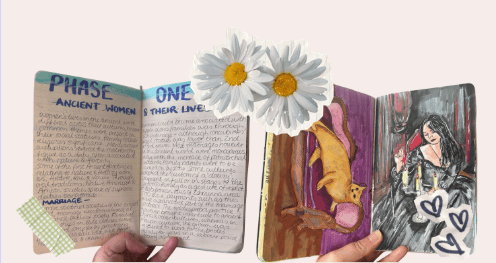
Make a Research Journal Page
This is something I have really started enjoying lately.
Choose a completely random subject that interests you and create a journal page about it.
It could be an artist, a historical figure, mythology, a place you want to visit, a flower, an animal, a book, an artwork, or some strange little piece of history you have fallen down an internet rabbit hole researching.
Add notes, drawings, printed images, little facts, quotes, colour swatches or anything else that helps you explore it visually.
It is research, but make it pretty.
Borrow a Journal Idea
Another new thing I have been doing is looking through Instagram for interesting journal pages and prompts.
There are so many clever ideas out there that I would never have thought of myself.
Find one that catches your attention and make your own version.
Do not worry about recreating it perfectly. Use the idea as a starting point and change the colours, imagery, layout or prompt to make it yours.
Sometimes you do not need to invent the idea from scratch. You just need something that gets you started.
Try a Material You Never Use
Raid the art cupboard, stationery drawer or craft box and choose something you usually ignore.
Oil pastels. Charcoal. Posca pens. Watercolour pencils. Ink. Collage. A cheap packet of crayons.
Give yourself permission to be terrible at it.
You are experimenting, not producing a masterpiece.
Go on a Creative Walk
Go for a walk with absolutely no intention of exercising efficiently.
Take photos of colours, textures, shadows, interesting plants, weird signs, cracked concrete, birds, houses or anything else that catches your eye.
You could even give yourself a tiny challenge before you leave. Find five different shades of green, photograph ten interesting textures, or find something in every colour of the rainbow.
Then use those photographs later for a journal page, drawing or colour palette.
Make Something That Has Absolutely No Purpose
This might be my favourite one.
Make something that you are not going to teach.
Do not turn it into a worksheet.
Do not photograph it for a resource.
Do not worry whether it belongs in your portfolio.
Do not ask yourself whether it is “good enough”.
Make something completely unnecessary.
Just because making things is fun.
And for my fellow academics and researchers…
Creativity does not disappear once we enter academia. Sometimes we just forget that research itself can be incredibly creative.
So, if you want to keep your brain gently ticking over without turning your holidays into another work week, here are a few prompts for you too.
Create a Research Curiosity Page
Open your journal and write one question in the middle:
What am I curious about right now?
Then let yourself branch out.
Add questions, authors you want to read, theories you have heard about, strange connections, possible research ideas, words you keep noticing, little diagrams or complete research rabbit holes.
Do not worry about whether any of it will become a paper, thesis or project.
Just be curious.
Research Something Completely Outside Your Field
Pick something you know almost nothing about and spend an hour learning about it.
Ancient mythology. Marine biology. Architecture. Neuroscience. Fashion history. Astronomy. Gardening. Folklore.
Read an article, watch a lecture or listen to a podcast and make a journal page about what you learnt.
Sometimes ideas appear when we step outside our own discipline.
Make a Visual Literature Map
Choose one topic you are interested in and map what you already know.
Write the topic in the centre and surround it with researchers, theories, key concepts, debates and questions.
Use arrows.
Draw connections.
Circle things you need to explore further.
It does not need to look academic. Make it messy, colourful and completely yours.
Read One Article Just Because It Sounds Interesting
Not because you need it for your literature review.
Not because your supervisor recommended it.
Not because you need another citation.
Choose a paper purely because the title makes you curious.
Then write down three things:
- Something I learnt.
- Something that surprised me.
- Something I now want to know more about.
That is enough.
Make an Academic Commonplace Page
Keep a page for little pieces of research that you want to remember.
Interesting quotes.
Definitions.
Ideas.
Theories.
Questions.
Statistics.
Authors you want to investigate later.
You could even add drawings, colour coding, sticky notes or printed images.
Think of it as a little collection of ideas rather than formal research notes.
Write About Your Research Without Academic Language
Explain your research as if you were talking to a friend over coffee.
No jargon.
No theoretical framework.
No methodology section.
Just:
What am I actually trying to understand, and why do I care about it?
Sometimes stripping away the academic language helps us reconnect with the reason we started researching in the first place.
Create a “What If?” Page
Give yourself permission to think ridiculously big.
What if I studied this?
What if I combined these two ideas?
What if I used a completely different method?
What if this became a PhD?
What if I collaborated with someone from another discipline?
What if I researched the thing I actually cannot stop thinking about?
You do not have to act on any of it.
This page is for possibilities.
Draw Your Research
Yes, actually draw it.
If your research were an image, what would it look like?
A tangled ball of string?
A tree?
A maze?
A constellation?
A series of overlapping circles?
You do not need to be an artist. Sometimes trying to represent an idea visually can help us see connections differently.
Make a Research Inspiration Page
Create a page dedicated to the people, ideas and experiences that have influenced you as a researcher.
Add researchers you admire, teachers who shaped you, books that changed your thinking, quotes you return to, conference moments, photographs, artworks or little reminders of where you want your research to take you.
A research vision board, but slightly less corporate.
Collect the Questions You Do Not Have Answers To
Academia teaches us to search for answers, but the unanswered questions are often the interesting part.
Fill a page with them.
Questions about your field.
Questions about your own research.
Questions you think nobody has explored properly yet.
Questions that might be completely ridiculous.
Do not answer them.
Just collect them.
Sometimes that little question sitting quietly in the corner of a journal page becomes something much bigger later.
Finally…
Your creative outlet does not have to become a finished artwork, a lesson resource, a journal article, something worthy of Instagram, or something productive.
You do not need to emerge from the school holidays having mastered watercolour, read seventeen journal articles, filled an entire sketchbook and somehow become a new person.
Sometimes creativity can simply be five minutes spent making, writing, researching, photographing, noticing or learning something because you wanted to.
For teachers and researchers, whose creativity is so often directed towards our students, our classrooms, our writing and our work, perhaps the holidays are a good opportunity to keep a little bit of it for ourselves.


Leave a comment