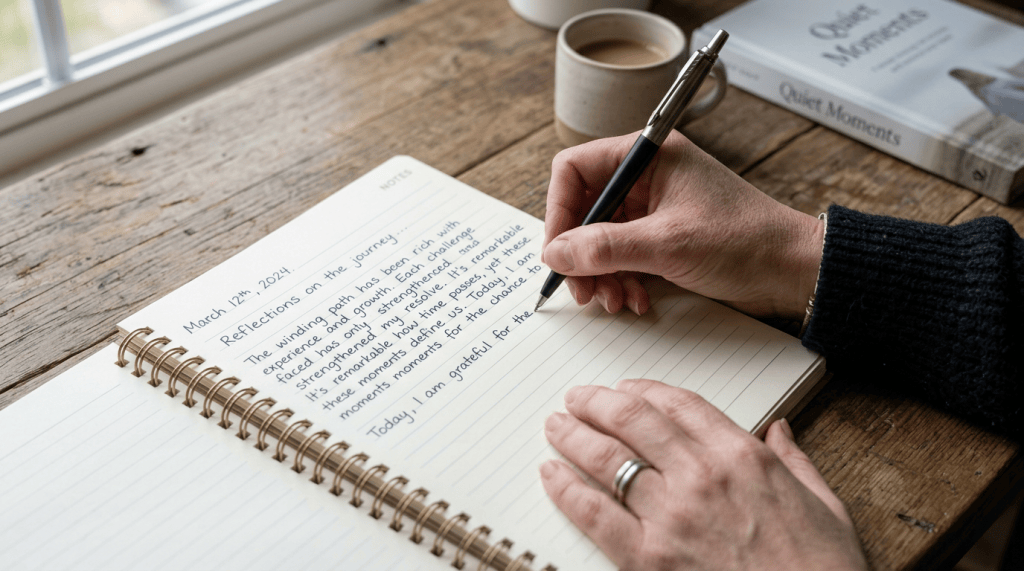
Handwriting has been in the news this week.
Following the release and discussion of recent NAPLAN results, there has been renewed debate about handwriting, screen use and whether students should be completing writing assessments with a pen rather than a keyboard. On 2 November, education ministers discussed a proposal to return NAPLAN writing tests to pen and paper, and it has since been reported that Year 5 students will return to handwritten NAPLAN writing from 2028, with further advice being sought about Years 7 and 9. Currently, only Year 3 students complete the NAPLAN writing test by hand.
As a classroom teacher, none of this feels particularly surprising.
It is becoming increasingly difficult to work with students whose handwriting is so poor that it is genuinely difficult to read. Almost every lesson now, I have students arriving with no materials. No book. No pencil case. Sometimes not even a pen or pencil. They arrive with a device, and that’s it.
In my junior Visual Arts classes, we rarely use devices. Students might refer to slides or access something I have provided online, but most of what we do happens physically. We draw. We paint. We annotate. We write. We experiment. Obviously this changes in Senior Visual Art, where students need access to devices to meet syllabus and assessment requirements, but with my juniors I deliberately try to keep that physical relationship with making and writing.
And something I have noticed more and more is a loss of writing stamina.
Not just handwriting ability.
Stamina.
The ability to sit down, think, write, make a mistake, cross it out, keep going and finish something.
What concerns me even more is the pushback I sometimes receive when I ask students to write anything of length.
Recently, students in one of my classes were asked to write one paragraph.
One.
They were writing a describe, interpret and evaluate paragraph about an artist. I explicitly taught the process. We discussed the artwork. We developed ideas together. I modelled the writing. We were doing it as a class.
About 40% of the students completed the task alongside me.
The remainder were a struggle, and for some students, getting them to write that single paragraph became an argument.
A paragraph.
Now, I also need to acknowledge that there is another issue happening here because this is Visual Arts.
There are still students who do not see academic value in the subject. Writing in Art is sometimes viewed as unnecessary because Art is supposed to be the “fun” subject where you just make things. So yes, some resistance comes from the ongoing misconception that Visual Arts should simply be practical.
But reading the discussion around handwriting this week made me think much more deeply about what I am actually seeing.
Because it is not isolated to one junior class.
I have received Year 12 handwritten drafts that are barely legible.
Year 12.
There is something confronting about realising that a student can reach their final year of schooling and still struggle to communicate their thinking clearly through handwriting.
Interestingly, the NAPLAN story itself is more complicated than simply saying that students cannot write because they use computers. ACARA describes the 2026 national results as broadly stable overall, although there has been a slight increase since 2023 in the proportion of students needing additional support in reading and writing. ACARA also cautions against overinterpreting the 2026 writing results because of a technical disruption that affected some students completing the online writing test.
ACARA has previously stated that NAPLAN writing is not intended to assess handwriting or keyboarding skills, and that its research found the quality of writing produced online and by hand to be similar at each year level.
So perhaps changing the NAPLAN test itself is not the complete answer.
Maybe the more important conversation is about what students are doing every day before they ever sit NAPLAN.
How often are they writing by hand?
How often are they drawing?
How often are they annotating something physically?
How often are they expected to persist with a written task without immediately moving to a device?
And how often are they arriving in a classroom expecting that their laptop is the only tool they need?
This is where I find Visual Arts particularly interesting.
I am lucky enough to teach a subject that naturally promotes fine motor skills. Students draw, paint, cut, construct, manipulate materials, annotate and write. There is a physicality to learning in an Art classroom that I think is incredibly valuable.
Research discussed as part of this week’s debate also points to the importance of handwriting for learning and memory, although experts have stressed that students need to become capable “hybrid writers” who can work effectively both by hand and digitally.
And I think that balance is important.
I am certainly not arguing that devices should disappear from classrooms.
Devices help us enormously.
They provide access. They allow students to research, communicate, create digitally and access resources in ways that simply were not possible before. During and following COVID, our capacity to maintain learning through online platforms became incredibly important.
But I do wonder about the fallout from that increased reliance.
Because the device did not simply enter the classroom as another tool.
For teachers, it also created another classroom.
We now maintain the physical classroom while also maintaining an online one.
Resources need to exist physically and digitally. Instructions are explained in person and uploaded online. Materials are distributed in class and placed onto learning platforms. Students who are absent need access. Students who lose something need another copy. Parents need information. Assessment needs to be available digitally. Communication needs to be maintained.
None of these things are necessarily bad.
But they are more.
More systems. More administration. More platforms. More places for teachers to maintain a presence.
And at the same time, I increasingly find myself asking students to please bring a pencil.
There is something slightly absurd about that contrast.
Perhaps this renewed discussion about handwriting gives us an opportunity to think more carefully about balance.
Not abandoning technology.
Not pretending that students will not need keyboards, devices and digital literacy in their futures.
But also recognising that technological capability should not come at the expense of other skills.
I have even changed the way I write on my whiteboard.
I used to naturally write in cursive. I rarely do anymore because too many students cannot read it. Instead, I find myself deliberately printing words, slowing down and simplifying my handwriting so students can comprehend what I am writing.
And yet, I still love being the teacher who writes on the whiteboard.
I handwrite my notes.
We build analysis paragraphs together.
We annotate artworks together.
Students watch ideas appear rather than simply having completed information projected onto a screen.
They see me stop.
Think.
Change a word.
Cross something out.
Add something.
Keep going.
And maybe there is something valuable in that too.
Because if I expect my students to write, I should write.
If I expect them to persist when their hand gets tired, I should model persistence.
If I expect them to make mistakes and keep going, they should see me doing exactly that.
Perhaps handwriting is not simply about whether students can form neat letters on a page.
Perhaps it is also about patience, fine motor skills, thinking, persistence and learning to stay with an idea long enough to develop it.
So yes, I am very interested to see where this conversation goes.
Because while NAPLAN might have brought handwriting back into the headlines, teachers have been watching this change happen in our classrooms for quite some time.
And maybe asking a student to write one paragraph shouldn’t feel like such a radical request.


Leave a Reply